
Controlling Plasma "Fluctuations" with Density: New Insights for Stable Fusion Operation
We investigated special fluctuations called "Low-Frequency Edge Harmonic Oscillations" (LF-EHOs) that occur in high-density plasmas at the Large Helical Device (LHD). We discovered that these fluctuations only appear above a certain density threshold and that their characteristics change as the density increases further. This finding suggests that we can potentially control the internal state of the plasma by adjusting its density, a crucial step toward achieving a stable operation in future fusion reactors.
Fusion energy is anticipated as a definitive solution to future energy challenges. Realizing fusion power requires stably maintaining an extremely high-temperature, high-density plasma, similar to the core of the sun, for extended periods. This plasma is confined within a magnetic "cage," and its performance is significantly enhanced in a state known as "H-mode." However, a challenge in H-mode plasmas has been the emergence of instabilities that can degrade confinement. While the Large Helical Device (LHD) can produce a stable H-mode plasma without these disruptive instabilities, it instead exhibits a persistent, oscillating fluctuation in the plasma periphery we named "Low-Frequency Edge Harmonic Oscillations" (LF-EHOs). The precise impact of these fluctuations on the plasma, particularly their relationship with "particle transport"—the process that moves particles out of the core—has remained poorly understood.
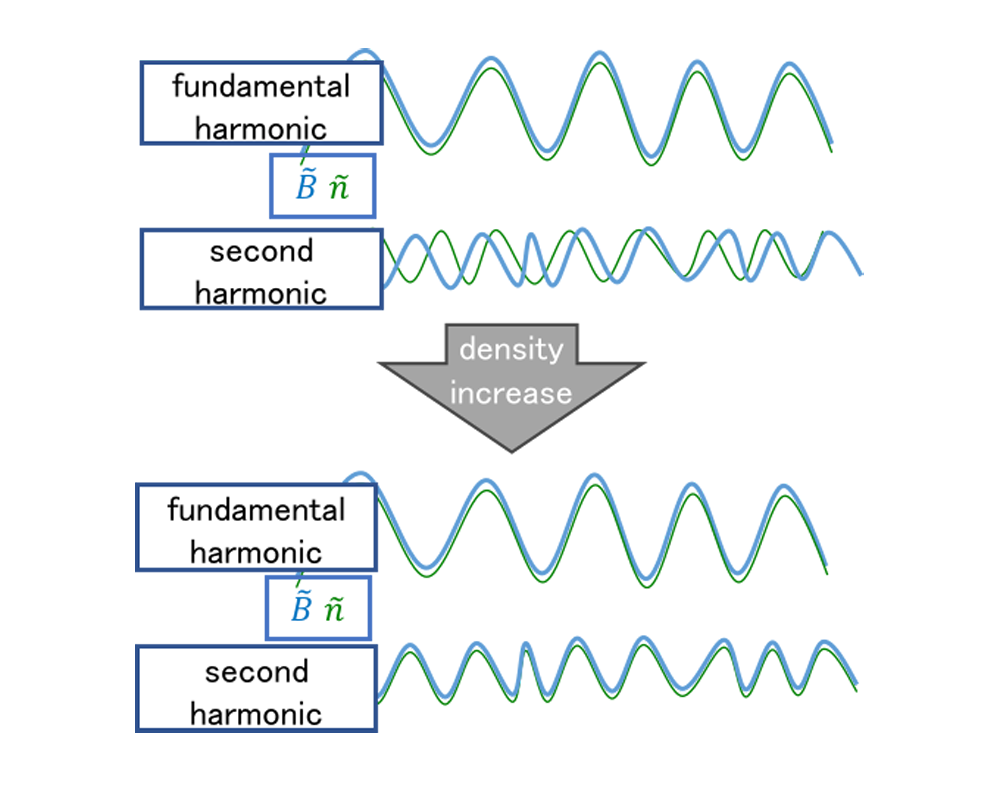
To unravel this mystery, our research group conducted experiments on the LHD, systematically varying the plasma density. We simultaneously and precisely measured the minute, rapid fluctuations in both the plasma's density and its confining magnetic field. Our investigation led to several key discoveries. First, we found that LF-EHOs do not occur arbitrarily; they only manifest once the plasma density surpasses a specific "threshold." This indicates that plasma density plays a critical role in triggering these fluctuations. More interestingly, we discovered that the nature of these fluctuations changes with density. Plasma fluctuations, much like musical tones composed of a fundamental note and its overtones (harmonics), consist of a fundamental frequency and its integer multiples. Our analysis revealed that at the fundamental frequency, the density and magnetic field fluctuations were always in sync, moving in a coordinated manner. In contrast, for the "second harmonic" (with twice the frequency), the two fluctuations were out of sync at lower densities. However, as we increased the density, they progressively fell into step with each other.
This phenomenon of "falling into step" is described in physics as an increase in "coherence." The coherence between density and magnetic field fluctuations is believed to be linked to the intensity of particle transport. Higher coherence implies that the fluctuations are more effective at transporting particles out of the plasma. Our findings suggest that by increasing the plasma density, we enhance the particle transport driven by these higher harmonics.
Our research, for the first time, demonstrates the potential to control the state of LF-EHO fluctuations, and by extension particle transport, by adjusting a key operational parameter: the plasma density. This provides a new scheme for tuning the plasma's behavior. This achievement is a significant step toward developing novel control schemes for maintaining stable, high-performance plasmas, paving the way for the steady-state operation of future fusion power plants.
This research result was published in Plasma and Fusion Research, an online journal by the Japan Society of Plasma Science and Nuclear Fusion Research, on October 17, 2025.
Publication
Glossary
*1 H-mode: Short for High Confinement Mode. A plasma operational regime in which the energy confinement is significantly improved, leading to higher performance. It is considered the standard mode of operation for future fusion reactors.
*2 Low-Frequency Edge Harmonic Oscillations (LF-EHOs): Persistent, wave-like fluctuations observed at the periphery (edge) of H-mode plasmas in LHD. They are characterized by a fundamental frequency and its harmonics.