
Discovery of the Two Roles of Plasma Turbulence in Heat Transport and Nonlocal Coupling
— Experimental clarification of the dual functionality of turbulence using high-resolution measurements —
Using the Large Helical Device (LHD), we have experimentally clarified that plasma turbulence plays two distinct roles in heat transport. High time- and space-resolution measurements directly revealed the coexistence of turbulence responsible for local heat transport and turbulence that mediates nonlocal coupling between spatially separated regions. In particular, turbulence excited by short-duration heating pulses was shown to rapidly connect the entire plasma and to mediate a global thermal response. These results provide a physical basis for understanding nonlocal heat transport and contribute to predictive control of heat propagation in future fusion reactors.
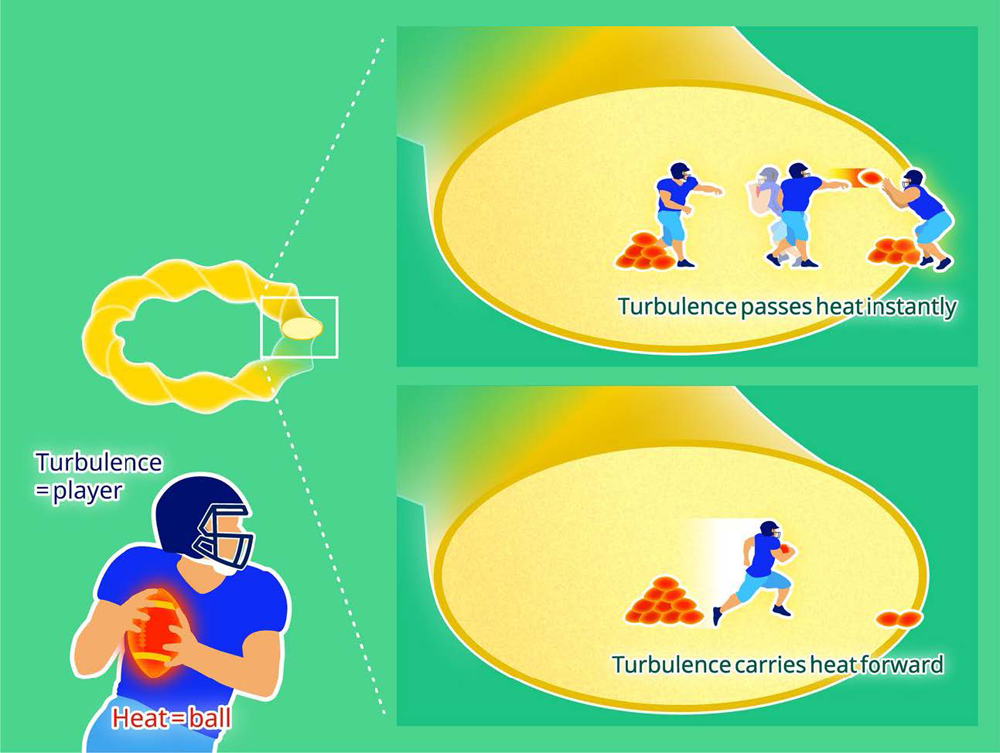
(Top) Turbulence responsible for nonlocal coupling (mediator). Low-frequency, spatially extended turbulence excited by localized heating rapidly links radially separated regions, producing a near-simultaneous global plasma response. This process is illustrated metaphorically by coordinated ball passing between players, representing the rapid mediation of thermal information rather than direct heat transport.
(Bottom) Turbulence responsible for local heat transport. Gradient-driven turbulence transports heat radially outward over longer timescales, forming the plasma temperature profile. This process is depicted as a player carrying the ball forward, representing the actual transport of thermal energy.
Achieving fusion energy requires the stable confinement of high-temperature plasma exceeding 100 million degrees using strong magnetic fields, while minimizing heat losses from the plasma core. In magnetically confined plasmas, turbulence driven by density and temperature gradients is ubiquitously present and dominates heat transport processes. Therefore, understanding and controlling turbulent heat transport is a key issue in fusion plasma research.
Conventional transport theories have primarily treated turbulent heat transport as a local diffusive process, in which heat propagates gradually from the core toward the edge. However, experiments have repeatedly observed situations in which a localized heating perturbation induces an almost instantaneous response over a wide plasma region, suggesting the presence of nonlocal heat transport mechanisms. Despite extensive theoretical and experimental efforts, the underlying physics of such nonlocal transport has remained unclear.
In this study, short-duration heating pulses were applied to the plasma core in the Large Helical Device (LHD), and the subsequent temporal evolution of electron temperature and turbulent fluctuations was simultaneously measured using multiple electromagnetic diagnostics with high temporal and spatial resolution. These measurements revealed the coexistence of two distinct turbulence components with fundamentally different roles in heat propagation.
Immediately after the heating pulse, a low-frequency, spatially extended turbulence component emerged and established correlations between radially separated regions within a very short timescale, shorter than 100 microseconds. This turbulence does not directly transport heat outward; instead, it functions as a mediator of nonlocal coupling, rapidly linking distant regions of the plasma and enabling a global thermal response.
Subsequently, conventional gradient-driven turbulence develops and transports heat radially outward over longer timescales, forming the overall temperature profile of the plasma. Thus, plasma turbulence simultaneously fulfills two roles:
- Nonlocal coupling, which rapidly connects spatially separated regions, and
- Local heat transport, which carries thermal energy outward in a diffusive manner.
Furthermore, we found that shortening the heating pulse duration enhances the turbulence responsible for nonlocal coupling, leading to faster global heat propagation. This result indicates that the temporal scale of external perturbations plays a crucial role in triggering nonlocal transport phenomena.
This work represents the first experimental identification of the coexistence of local and nonlocal turbulence in a magnetically confined plasma, achieved through high-resolution measurements. By clarifying the physical origin of nonlocal heat transport, these results provide an essential foundation for predicting and controlling global heat responses in future fusion reactors.
Future studies will focus on systematically identifying the conditions under which mediator-type turbulence is generated and exploring strategies to control it, with the goal of achieving improved heat confinement. Moreover, the concept of rapid nonlocal coupling revealed in this study is expected to be relevant to a wide range of nonlinear systems beyond plasma physics, including fluid dynamics, geophysical flows, and energy transport in materials.
This research result was published on December 10, 2025 in Communications Physics, an open-access journal in all areas of the physical sciences.